A year of existence / Potential puppies / Same house but different

It’s been hard to find time to write here recently, so I’m going to have a brief flick through the recent headlines and look forward to the impending summer.

First thing, Milan Curtis Errington / Meishulei / Leilei has now been around for a whole year – nine months on the inside and three on the outside. It’s not something people generally celebrate, but maybe we can start a trend. He’s still growing, drinking milk, occasionally sleeping and waking up and crying, generally the standard baby behaviour, and we’re used to it enough to not be shattered any more. Recently he’s been going through a phase of trying to rub his eyes, and we’ve had to put gloves on him to stop him scratching his face. This is also normal, though I’m mystified as to what parents did in the days before baby gloves and dummies. Recently he looks like he’s getting ready to say something, but since both V and I didn’t speak until we were nearly 2 and bilingual babies take longer we’re not anticipating anything that soon.

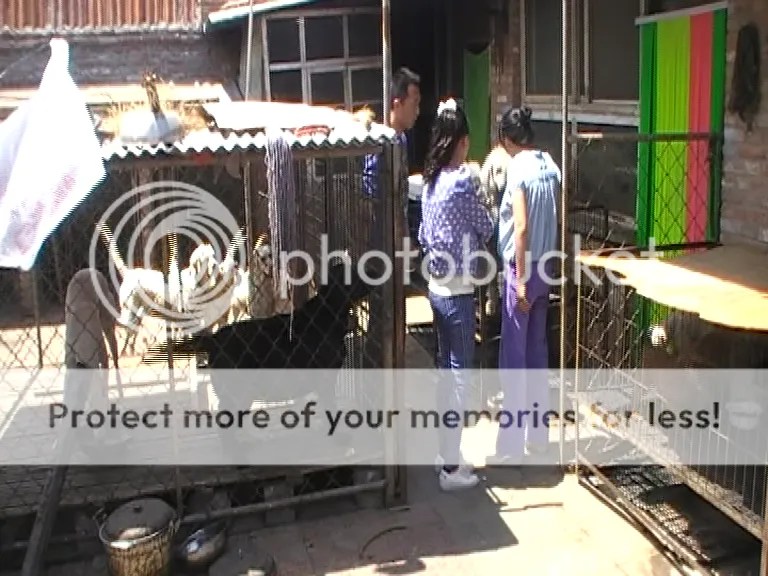
Meanwhile sister-in-law has moved back into the family house, and her first project has been to get the dog pregnant. Bedlington Terrier puppies are worth over £200 each in China, so poor Xiaobei has been taken for a couple of meetings with her new “boyfriend”. He’s another Bedlington, but twice the size and living in a dog farm on the edge of Tongzhou – a place I’d describe as the 15-year-old-me’s worst nightmare. We went into a back room with a few sofas and a computer for the consummation. V, her sister and her fiancée hadn’t seen dogs in action before and found it pretty shocking, though I had warned them. Afterwards Xiaobei’s “boyfriend” had a wee on the sofa. It makes sense that nobody’s ever bothered to toilet train him.
So in two months, with any luck, puppies.

The final item is less interesting, but probably more important. Our tenancy is up in three months and we’ve got to decide what to do for the next year. I want to move back to the centre of course, but am having to get used to the fact that it’s not really a practical idea. To this end we’ve been looking at the other available flats on the estate. Today I and V had to followed her sister at a distance as she was taken to view a place, in order to find out who the landlady was and make a private deal with her without the agency taking their cut. Then they went back and found her, while I went home so we could avoid getting the foreigner price. It was too expensive in the end, but the cloak-and-dagger stuff was fun anyway.

Oh, and summer’s here! And it’s too hot! And now there’s a thunderstorm outside.

Posted in diary | Tagged , | Leave a comment

Silver Apples in Beijing

Last weekend we went to see the Silver Apples. Who are the Silver Apples, I hear some of you ask. Well, their first album, released in 1968, sounds like a mish-mash of krautrock, electronic pop and sampling, all of which were yet to be invented. There are just two members – Simeon Coxe III, who plays an array of home-made synthesisers and sings, and drummer Danny Taylor, dead since 2005, but still alive in his tape loops. I’m not sure if they were really influential, they were perhaps too far ahead of their time for that.
What better choice could there be for V’s first ever gig? Many, most likely, but I didn’t want to miss this chance to see them, and none of my friends here have ever heard of them and would be unlikely to shell out 150 kuai for the privilege.
We got to the venue – Yugongyishan – at 9pm, the time I’d been told the bands would start. In reality nothing got underway for over an hour (a surprise to V, not really a surprise for me), so we hung out in the strange sofa annex they have upstairs.

We watched the support bands from our seats in the back section. The first were a local experimental noise outfit, not producing anything really worth listening to on the whole, but who occasionally seemed to have fantastic ideas, quickly subsumed by walls of electronic feedback. Give them a few years and maybe they’ll come up with something good. The second band were from Hong Kong, a more professional, multi-instrumental deal, still experimental, more professional and with more variety, but with a few of the rough edges taken off. They were also mediocre, with fits of greatness.

It was past 12 when the Silver Apples came on, or rather the Silver Apple. Only Simeon remains in the band, but you’d be hard pressed to notice if you closed your eyes. He’s 73 years old now, and looked a little frail – unsurprising after the coach crash that nearly killed him a decade ago – but his singing voice was still very much there.

To make the event more visually appealing there was a screen showing a close-up of the “instrument” throughout. “How did he bring it all to China,” V asked. I have no idea. Watching the screen you could attempt to work out which parts were samples and which he was actually playing.

I had feared that Beijing would be completely uninterested, but the venue was packed. When the opening to ‘Oscillations’ began the whole crowd cheered, and then started to sing along. This wasn’t an ex-pat audience either, looking around at least 90% of the audience were Chinese.

I’m no music writer, so I won’t attempt to describe the quality of what I heard beyond “it was good.” I would have loved to have seen them in the sixties, but this is as close as I’m going to get, and still a unique experience. One new song was my favourite – a spoken word piece with a repeated coda of “I don’t know, I don’t know, I don’t know…”
Can experimental music be fun to listen to? I know many, many people who think it’s a case of the emperor’s new clothes (an argument that’s always struck me as being terribly arrogant – “I don’t like it so anyone who does must be pretending to in order to impress…. someone….”) but when the set was over it seemed like the entire crowd were shouting “we want more” and that they really meant it.

Except, perhaps, for V. It was nearly 1am by this point, and she was so tired she had to lie down on a sofa. She said she enjoyed the gig, but I think it wasn’t that accessible for her. Anyway, she enjoyed the night out, and when we get to the UK she can tell people her first gig was the Silver Apples, in Beijing, at the age of 31.

Posted in diary, music | Tagged , , | Leave a comment

Journey To The West

I don’t know as much as I should about Chinese culture, but I’m a busy man, and it’s hard to change that. How can I educate myself in 2000 / 3000 / 4000 + years of culture while doing a 60-hour week, spending time with my family and not giving up any of my other various interests? It would be good if someone came up with a short reading list to get me up to speed, and what do you know, it looks like someone has already.
The “Four Great Classical Novels are “the four novels commonly counted by scholars to be the greatest and most influential of classical Chinese fiction” and I’m going to have a go at reading all of them this year, as well as The Plum In The Golden Vase, which was thrown out of the Four Great Classical Novels for being too sexy.

I’m starting with “Journey To The West”, also known as “Monkey” as it looked the most immediately accessible. It was most likely written by someone called Wu Cheng’en in the early-mid 16th century. To get an idea of timescale, that’s just before Shakespeare was born. Language and writing style shifts so much over 500 years that the book is now very heavy going, and the length of it makes it even more daunting – it has 100 chapters, none of them particularly short.
Fortunately then I didn’t need to read it in Chinese, and the most famous English version by Arthur Walley is quite significantly abridged. In a sense it’s a bit of a cheat, but short of setting aside a half-decade to learn to read classical Chinese it was the only option. Translation is part of the art, anyway, and if I were Chinese I’d love to read modern, accessible versions of Shakespeare or Chaucer.
“Monkey,” as Walley named his translation, is the story of a monk traveling from China to India in order to bring back Buddhist scriptures. It was possibly based on a true story, though it’s unlikely that in real life the monk had a monkey spirit, a pig creature, a swamp ghost and a dragon disguised as a horse traveling with him. Of course, Monkey is the real star of the piece. The first third of the book (or 7% of the unabridged version) concerns his birth (from a stone egg), his religious training resulting in godlike superpowers and various simian japes played on the gods until they are forced to give him the name of “Great Sage, Equal of Heaven”. Then it all goes a bit wrong, he’s put in charge of a peach orchard in heaven and unsurprisingly eats all the peaches and then steals a whole banquet for the other monkeys. This is a bit too much for the gods and he’s imprisoned under a mountain for 500 years to cool off a bit.
The rest of the book concerns the journey – first the monk’s backstory, then his encounters with each of his companions before it settles down into episodic tales of the things and people they encounter on their way to the west. These vary from minor issues with monsters devouring first-born village children to major trials such as restoring a king who has been usurped by a shape-shifting magician. Finally they reach India, bring the scriptures back to Xi’an and are changed into immortals for their trouble.
It was quite enjoyable on the whole, better when it wasn’t hammering home the fact that it’s one long Buddhist parable, and all the better for the focus brought to it by Walley. Sometimes I felt I was reading an ancient scripture, sometimes one of Grimm’s most lurid fairy tales and sometimes even a particularly out-of-the-box modern fantasy novel (not that I read those).

Next week I’ll see if I can find a good modern version of

Posted in literature | Tagged , | Leave a comment

English in China: Accent

One of the most disheartening things about English teaching in China is the way that gut instincts and what we call “first language interference” are allowed to interfere with education almost completely unfettered by awareness of what English actually is. The most glaring example of this is an obsession with “correct” pronunciation which all but destroys any hope of ever speaking the language fluently.

There is a common misconception here that there is something called “correct English pronunciation,” – a misconception that’s perfectly understandable when you know something about the Chinese languages. I say “languages” because by any definition Chinese is at least six or eight languages rather than dialects. The idea that they have many dialects of the same language comes from the fact that they use a single writing system. Characters represent words rather than sounds, so it’s possible to print a single text and have it read in any one of the different languages*. This has led to the idea that there is a single language which people speak with different accents, but this idea falls apart when you consider that even English could be written in Chinese script, though the word order would be fairly strange.
All these “dialects” are not equal, however. An adapted form of the Beijing dialect was selected as the national language, what we generally call “Mandarin” in English. This is the language of education and the media in China, so the vast majority of people will use a local language at home but will use Mandarin at school and watch Mandarin TV. Because it’s an artificially maintained language (and already quite different to what modern Beijingers speak) there is a very clear line as to what is correct and what is incorrect.
I should add to this the fact that Chinese languages are tonal. This means that what sounds like a single sound to an English speaker can represent four (or sometimes five) different sounds to a Chinese speaker. A famous example of this is the sound ‘ma’ – speak with a flat tone and it means ‘mother’, a rising tone and it means ‘numb’, a falling tone and it means ‘scold’ a falling-then-rising tone and it means ‘horse’ and with a high unstressed tone it turns the sentence into a question. You can imagine the trouble you can get into if you get these tones wrong – not just embarrassment but complete incomprehensibility – so it’s vitally important that Mandarin be spoken accurately. Pronunciation is therefore ruthlessly maintained, and since everyone learns Mandarin at school their impression of language learning is that much of it involves the correction of non-standard pronunciation.

Let’s skip to English now, a language you should be more familiar with. There’s American English, Australian English, Canadian English, British English…. but even these names hide an even greater variety – British English for example consists of a host of different accents / dialects. While we may sometimes have difficulty, in general native speakers of English can communicate with each-other without any major problems. You can even speak to Indians, Germans or Italians with strong accents who nevertheless are able to communicate in English with very little trouble. If there is such a thing as ‘Standard English’ then, it’s some kind of midpoint between all of these – a basic framework which we all build on. Getting that part right is essential, but copying an accent is somewhere close to pointless – it only makes you look like you’re trying to hide where you’re from.
On Thanksgiving Day** in 2009 I was press-ganged into judging a speech competition at a school here in Beijing. One of the contestants was an eleven-year-old girl, and when she opened her mouth I was surprised to find her talking like a character from a Jane Austen novel. Later her teacher came up and talked to me to ask whether I was impressed with how well she’d trained her. Maybe I should have told her off for wasting the girl’s time. I could have mentioned that accent is a marker of regional and class belonging in the UK, that people will judge you for being from the north or the south, for being upper class or working class. Maybe I should have reassured her that there’s nothing wrong with having a Chinese accent, so long as people can understand you, and that British people will be a lot more open to someone who sounds Chinese than someone who has adopted a strange, artificial, outdated accent as little more than an affectation. But I didn’t say any of these things because there was little point in upsetting her, and because the little girl seemed to enjoy pretending to be Lady Catherine de Bourgh.

The area where I do try to change things is in my main job. Since I train English teachers I have an opportunity to try to convince them that pronunciation is only an issue so far as it prevents understanding, but this can be a hard nut to crack. One teacher came to me and asked which was the correct pronunciation – hat (rising) or hat (falling). “I can’t hear any difference” was not the answer he was looking for. The nadir came when I had a hard time persuading the other staff that we weren’t going to make teachers’ accents one of our main evaluation criteria. Even when I’ve explained all of the above the argument I faced was that schools will employ teachers with more “accurate” accents and we should prepare them for the job market. Perhaps even the schools themselves understand the matter, but parents certainly don’t, and since they are the ones paying the money, what they say goes.

It seems an insoluble situation as much as it is an unfortunate one. For my part I try to spread the word as much as I can (and now our company is starting franchises this may be quite a bit), but the scales are weighed heavily against me on this one, and for the foreseeable future students in China are going to waste a huge amount of time practicing the pronunciation of words they’ll never be able to put into realistic spoken English.

*This is a bit of an oversimplification, but it’s basically true.
**I had to make a speech telling them what Thanksgiving was all about – unfortunately being English I only have a vague idea, but I was able to bluff my way through it fairly well.

Posted in diary | Tagged , , | Leave a comment

Strawberry Music Festival 2011

Last weekend I found out that there was going to be a music festival in Tongzhou. A festival! Even the idea that there would be a gig in Tongzhou seemed fairly unlikely. I remember being quite excited when a western-style cafe opened near the house. That’s our usual kind of cultural highlight.
Somehow I persuaded V to come along with me. We had a look around the periphery on Sunday, when there were way too many people there, then we came back on (May Day Bank Holiday) Monday afternoon, bought tickets and got in – the whole process taking around five minutes (+1 to Chinese festivals).
The first stage we saw was the metal stage, altogether too shouty for V and, yes, not actually very good anyway. The underground metal scene around here is notorious, but not in an interesting way.
We wandered around for an hour or so, lying around on the grass, eating the usual terrible, expensive food and checking out the stalls, which weren’t bad overall – a mixture of the crafty Nanluoguxiang-style mini-boutique items and some secondhand clothes, which I’ve never seen sold in China before. Then we climbed up a hill to a little valley which housed the main stage. A Japanese post-rock band were playing, and they sounded pretty good, though the sound system couldn’t take the loud bits and one speaker kept cutting out. Just hearing post-rock played in Tongzhou is amazing enough, so it was quite enjoyable anyway.

Photobucket

Photobucket

The sun was setting and it all looked very pretty.

Photobucket

Photobucket

The next thing we heard was a traditional Mongolian rock fusion band on one of the smaller stages. They were ok. We mainly enjoyed their dancing.

Photobucket

The sun was going down by this point, and V was getting cold, so we went to buy a jumper for her to wear. On the way we found a “Tongzhou Tourism” stall, utterly deserted.

Photobucket

The last band we saw a whole set from were 二手玫瑰 – Second Hand Rose. They were four middle-aged transvestites from Dongbei, their music sounded a bit like the Cardiacs crossed with Mr Bungle, and generally they sounded and looked far more left-field and interesting than anything I’ve heard before in China.

Photobucket

It was a surprisingly well-organised festival. There were bins, everything was easily accessible, the toilets were even fairly clean.

Photobucket

It was getting on for 10pm and I had work the next day, so we made our way to the exit, stopping only when we found a small stage with a dj playing seriously hard & fast drum & bass. The small crowd were going crazy – slam-dancing, spinning and throwing each-other, crowdsurfing – while four policemen stood back wondering if this was a riot, and whether they should intervene.
This was the closest I dared get the camera (though I did nip in for a dance too):

Photobucket

The bus home was horrific, substantially worse than the usual Beijing standards. Even V looked scared she was going to be crushed in the stampede. We got home within the half-hour. V’s parents were still up and we had a go at explaining where we’d been, but it wasn’t really for them.
A good day off from the routine, then, and something we have to do properly next year, if it goes ahead.

Posted in diary, music | Tagged , , | Leave a comment

Where we live

A couple of months ago I had a walk around our estate and took some photos. It’s spring now, and they’re already out of date insomuch as everything looks grey, and there’s no blossom on the trees, but here they are anyway.

Tongzhou is a suburb on the edge of Beijing. Somewhere above a million people live here, but nobody seems sure of the exact number.
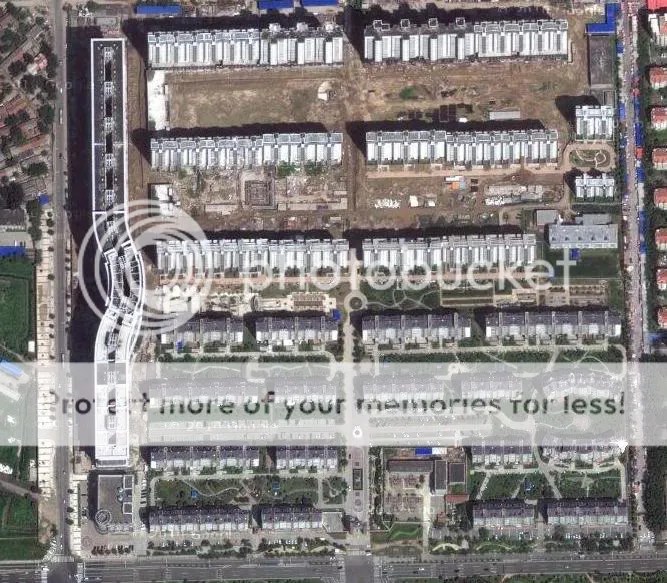
My estate’s name translates as “Era Century Star City” apparently. It’s got a good right to call itself a city, it’s bigger than many British towns. It includes 96 apartment buildings, some of which are massive. Here it is from the air (thanks Google maps!)

The entrance is a massive faux-Roman swoopy thing, with a giant archway.

On the other side the estate is organised in massive rows, a bit like this

A shame I took these photos in winter, it probably looks a lot nicer now.

The sun reflects on the buildings in unusual ways. I should do a timelapse later, maybe.

Fans of Chinglish, here’s your fix.

My bike is one of these.

Posted in diary | Tagged , | Leave a comment

Things I’ve seen on the internet this week

50 Unexplainable Black & White Photos

None of them actually “unexplainable,” but worth a look anyway.

Amazon.com Mr Men reviews by Hamilton Richardson

On Mr Uppity;
“In a thinly-veiled reference to the oppression of the workers by the ruling class, we are told that Mr Uppity is rude to everyone, and the detail that he has no friends in Bigtown explicitly informs us that the masses are on the brink of revolution. Are we about to bear witness to class war, Hargreaves-style? To see Mr Uppity brought to account by the revolutionary power of the proletariat? Vanquished and overthrown by the party of the workers?
Not so. Mr Uppity is no Marxian analysis, no Leninist prescription for class action. As always, Hargreaves’ inherent and essential conservatism comes to bear. His critique of the bourgeoisie comes not from the proletariat but from the feudal aristocracy. It is the authority of a king that places limits upon Mr Uppity’s excesses, as his usurpation and arbitrary exercise of power has violated ‘the natural order of things’. Hence the protection the masses are dealt in response to this transgression is paternal, and they receive it as subjects not radical agents of change. ”

Chicks With Steve Buscemeyes

Pretty sure everyone who wants to see this has seen it already, but here it is anyway. Horrible, horrible but can’t look away.

Posted in diary | Tagged | 1 Comment

Speeches and donkey burgers

It’s hard to teach a TEFL course in China when no Chinese know or care what a TEFL course is, and anyone with white skin and a native-ish accent is considered qualified enough to be a university teacher, so our number of students is moreorless flatlining – last month we had just three, and the office has eight staff. The plan we’ve arrived at is to franchise the course to local universities, which means going there, making a presentation to a lecture theatre full of undergraduates, then training a couple of their staff, providing them with materials, etc. It’s a bit of a change in direction, but it’s already looking a lot more promising.
Yesterday we went to Baoding, a small local city – small meaning only a million people live there, and local meaning about a hundred miles away. I had been hoping to get back to Beijing in time for dinner with V, but after the university delayed our presentation until 4pm I realised it wasn’t going to happen. We ended up spending about five hours in the car (i.e 2½ each way), not a problem as it gave me a chance to finish reading Journey To The West and catch up with a few hours-worth of podcasts. Arriving at the unremarkable university we were ushered in to an auditorium with about 300 students, but no projector or computer – apparently it hadn’t occurred to the staff that we might need these, so there was another half-hour delay while these were sorted out, and we didn’t get onto the stage until nearly 5pm.
Back in the days before I started teaching I didn’t use to be a particularly confident person. Has this changed? Not sure really, but speaking in front of a hall-full of people doesn’t seem to be a problem any more. I can still be apprehensive about interviews, but not in any incapacitating way. Is this self-confidence? It doesn’t feel liberating or exciting, but at least there’s no panic there any more.
Anyway, the crowd were unresponsive even for China, and we were wondering if there was something wrong, but no, over a hundred were interested in joining the course. They’re going to need to speak up a bit more if they’re planning on following the communicative approach, but someone else will be training them, so it’s not going to be my problem.
After the presentation we went for dinner. Baoding’s local speciality is the donkey burger, so we had that.

I’ve tried donkey meat in Beijing before (I think it may be V’s favourite meat), but this time it was much better. The bun was a proper north-eastern pancake instead of stodgy mantou, the meat wasn’t too salty, and importantly there were no chopped green peppers inside. We also had a salad – pickled vegetables an a white jelly-like substance called “Menzi”. “Is it meat?” I asked. “No,” said Lee. “What’s it made from, then? Tofu?” I asked. “No,” said Lee, “they boil the donkey’s skin…” – and apparently that doesn’t count as meat. It doesn’t sound very nice, but it wasn’t bad actually.
Laoban then ordered some sliced donkey penis, and that was where I had to stop. I’ve eaten enough strange things, but it just didn’t look edible, just like slices of gristle. Lee & Laoban seemed to like them though.

Posted in diary, food tube | Tagged , , | Leave a comment

General housekeeping, etc

It’s been a while since I’ve had enough time to just sit down and write something. This week, though, we seem to have no students, so I’ve given myself the task of updating the course handouts – not a particularly challenging task, and one that I can accomplish with a few half-hour breaks to do other things. So I’ll take the chance to talk about the last month’s happenings and come back later in the week to write less me-based blogs.
After a series of little holidays I’m back on a full work schedule – 9am-6pm Monday-Friday plus evening classes each day and daytime teaching on Saturdays, and a 90 minute commute – and therefore am not seeing that much of M or V or V’s parents – just Sundays and an hour in the evenings really. This is clearly not sustainable, etc etc, but I’ve whined about it enough already and I quite enjoy my jobs, even if I am a bit tired.
Milan / 梅书雷 is doing well. Getting on for two months old he’s focusing on objects and occasionally smiling, and that’s about all you can expect from a baby of that age. He’s got a huge variety of facial expressions, though – and I’m still uploading photos here every now and again if you feel like taking a look at them. The triad boss is my current favourite look. He’s still not sleeping more than a few hours at a time, so V’s sleep pattern is pretty strange now – thankfully we’ve got her parents to help out, even if she doesn’t get on particularly well with them some of the time. We’re considering getting our own place again in September and are reasonably confident that we’ll be able to manage on our own by then. It’ll be a bit of a struggle at first, I’m sure, but everyone’s got to learn these things sometime.
In short, life is pretty routine right now, and not that interesting to write about. The only break we had was when my mum came to visit from England a couple of weeks ago. This time we didn’t really go out anywhere apart from the shops and a nearby pagoda, but it wasn’t really a travel thing this time – more a chance for her to get to know M and V. She had lots of useful tips on baby care for V and put her mind to rest on all the usual worries.


Yes, I think it’s a girls hat too, but the colour-coding babies thing hasn’t really got to China yet.

Posted in diary | Tagged | Leave a comment

Les Rougon-Macquart #2 – La Curée (1871-2)

AKA “The Kill”

The second book in the Rougon-Macquart series takes a secondary character from the first novel, and transplants him to a new place with a more flexible class structure, an even more flexible morality, extravagant opulence and opportunities to make huge amounts of money – Paris. Aristide was one of the more openly odious characters in The Fortune Of The Rougons. His cynical social climbing in that novel led to him running an ill-advised revolutionary newspaper, a scheme that almost ended in his ruin. In Paris he adopts a new name – “Saccard” – and a new wife, after the convenient death of his first. That his marriage to Renée is arranged for purely financial reasons is perhaps ironic, considering that her romantic passion ends up being one of the dominant threads in the novel.

While the book is superficially about Saccard, the tale of his ill-gotten riches ends up as the ‘B’ story to Renée’s ‘A’. In a sense this is a shame as embezzling is a more unusual topic than romance, but generally it’s a relief to get away from the descriptions of complex financial scams, which sometimes confused me as much as they did their victims. His main source of income is using his prestigious civil service job (provided by his brother) to find out about new boulevards planned in Paris, buy up houses due to be demolished to make way for them, then use his influence to gain huge amounts of government compensation for their destruction. Later on he opens a bank and an investment corporation and starts actually building mansions along the boulevards. As his riches multiply so do his extravagant outgoings, so by the end of the story he’s descended into the “one last scam to pay off my debts and keep me rich” trope, but the expected downfall never comes. His lust for status is topped only by his love of money, but his interests don’t seem to stretch beyond these goals. He hosts lavish parties, eats the most expensive food and lives in a gigantic mansion, but none of this truly interests him – all is just a route to higher status and more money. He even fakes an affair with a society woman to further these aims.

Meanwhile, the heart of the story concerns his new wife, Renée, and his son Maxime. These two pampered, selfish creatures elevate themselves to the heart of Paris society, where they are so successful that they have nothing left to do but have an affair with each-other. The descriptions of their parties, their clothes and their habits shows such luxury and excess that it starts to get tiresome fairly quickly. Perhaps the point is to make the reader feel as world-weary and jaded as the pair themselves, but this may be wishful thinking. Reading about opulence without squalor is like eating a bag of sugar – it’s pleasant at first but it’s going to make you sick rather than satisfied in the end.
It’s difficult to feel sorry for such pampered creatures as these, but that really is the point – they aren’t particularly sympathetic in any way. Zola said that his aim with this storyline was to show “the terrible social breakdown that occurs when all moral standards are lost and family ties no longer exist”, which indicates the real problem a modern reader has with this book. These days most educated people understand that moral codes change over time, and rather than take them without question we should try to think about why they are in place. The 19th century attitude that Zola expresses takes a very different tack – the life of luxury and decadence Renée and Maxime have wears away their morals and leads them into the moral crime of incest, which should be scandalous, but is it really incest? She isn’t his mother, her marriage to his father is a sham, she doesn’t know him during his childhood and their relationship is never anything like that of mother and son. Their crime is to go against the accepted morality of their time, but you can’t help but notice that they don’t actually do anyone any harm. A modern writer would have to confront this point, but here it just lies unaddressed. The idea that hedonism is morally corrupting has also been left behind in the 19th century, and it would be nice if a case could be made for it rather than it just being left as something we understand to be true. I can’t blame Zola for any of this, but it does make the book as a whole less enjoyable and less effective than it should be – a museum piece rather than something which can be enjoyed on its own merits.

Translation

“La Curée” literally means the part of the game thrown to the dogs to keep them happy at the end of a hunt. In the interests of brevity, therefore, it’s generally been translated as “The Kill”. I read a 2004 translation by Brian Nelson. He had a difficult task – lengthy descriptions of beauty and opulence are not suited to a modern taste, but cutting them down would result in being unfaithful to the intentions of the original text. It wouldn’t really be fair to pin the blame on him, but I found the style a bit heavy-going and ponderous.

Historical background

The events of the story take place during the early years of the French Second Empire. The new emperor, Napoleon III, allowed civic planner Georges-Eugene Haussmann to spend a huge amount of money knocking down most of Paris and building huge modern boulevards. All this money, coupled to the non-egalitarian effect of jumping back from republic to monarchy, led to the blossoming of a new “nouveau riche” upper class with extravagant tastes and little concern for the well-being of the general public. Zola was clear in stating that the characters were based on real people, asking “Should I give the names and tear off the masks in order to prove that I am a historian, not a scandalmonger? It would surely be futile. The names are still on everyone’s lips.”

Naturalism

The inheritance of greed and lack of qualms in the Rougon family is all too clear – beyond this personality trait, however, the principles of naturalism aren’t applied to the characters in any great way. What is clearer, however, is that naturalism here has more to do with reflecting the themes of the novel – immorality, gluttony, decadence – in the style of writing, and this is much more successful. I can’t help but feel jaded myself, and hope the next novel will deal up some squalor to help the opulence go down.

Film

Roger Vadim, director of ‘And God Created Woman’ and ‘Barbarella’, produced a modern-day version of La Curée in 1966, starring his then wife Jane Fonda. There’s surprisingly little in the way of information about it available on the internet, but I was able to find two short clips, here and here (NSFW). It doesn’t look like much cop really, and the reviews I’ve seem generally seem to agree that it looks nice but isn’t really worth the bother of watching.

Posted in literature | Tagged | Leave a comment